
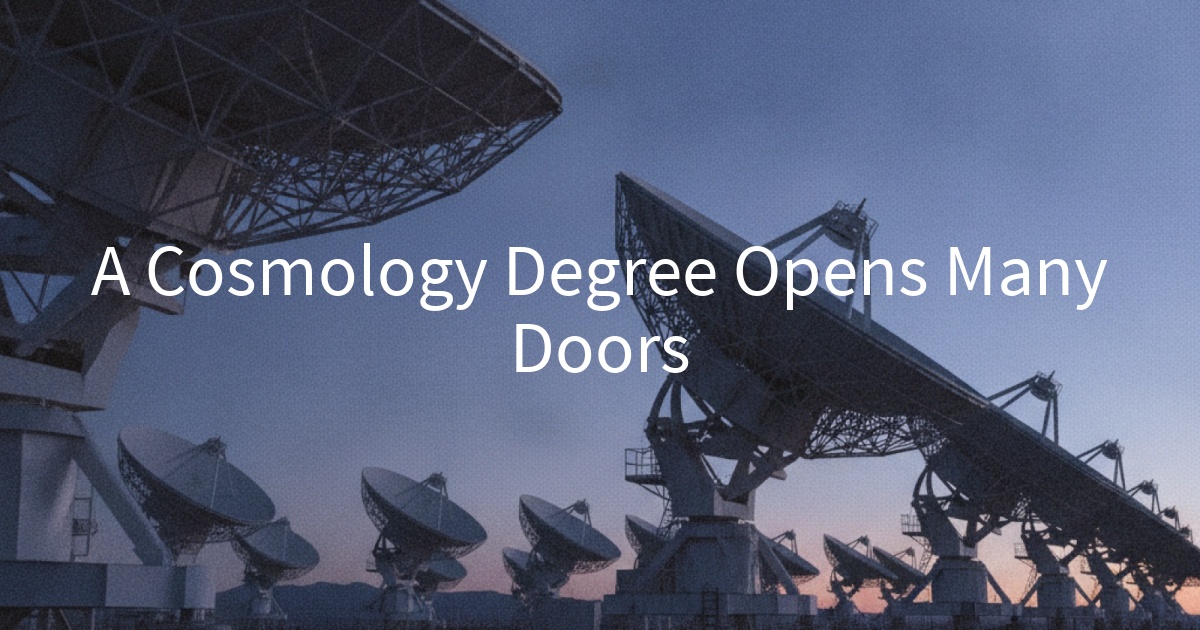
A cosmology degree requires a Ph.D. in mathematics, astronomy, or physics. Graduate students must have a strong foundation in each field and pursue expertise in one component. A strong background in advanced mathematics, such as calculus and computer programming, is also important. Cosmologists must have a solid background in classical physics, quantum mechanics, optics, and thermodynamics. They must also have an aptitude for interpreting and explaining their findings.
Cosmologists use ground-based telescopes and space-borne telescopes to observe astronomical objects and obtain data from them. The data obtained during observations are used to test theories on gravity, astrophysics, and the nature of the universe. The results of cosmologists’ research can lead to advances in astronomy, electronics, navigation, and medical technology. Cosmologists can work for public or private organizations, or as independent consultants.
The career path for a cosmologist starts with an undergraduate degree in physics or astronomy. Graduates can apply for internships at the American Astronomical Society and the American Physical Society. Postdoctoral research positions often allow cosmologists to apply their advanced knowledge in a practical setting. These positions also give them valuable experience working with renowned scientists and allowing them to provide feedback and guide their development. A cosmology degree will open many doors for those who seek employment in academia or government.
After graduation, a cosmologist can apply to jobs in academia and government. After completing the degree, many students find jobs in astronomy departments at universities and research groups. While most cosmologists will work in university laboratories, others can land a postdoctoral research position. After graduation, a cosmologist can then continue to pursue a full-time career in science. This field is a great choice for anyone looking for a career in astronomy.
In addition to the job market, a cosmology degree can help you find a career in the field of astronomy. Depending on where you live, you may choose to start an academic career in astronomy or cosmology. However, you may be interested in a career in cosmology in government, research, or academia. In addition to astronomy, a cosmology degree will also open doors to many other careers.
Cosmology Degree
In addition to cosmology, a cosmologist may pursue a career in astronomy or astrophysics. A cosmologist will need to have a Ph.D. in a related field. An undergraduate major in astronomy should take a course on the universe. This will give them a broad understanding of the universe and its processes. While the degree itself does not guarantee a career in astrophysics, it does provide many benefits.
When considering a cosmology degree, you should consider your future goals and possible career options. You may have a passion for science and want to make a difference in the world. You may want to join a research institute or work for a government agency. The cosmology degree can be a great way to help you advance your career. It will also enable you to work closely with other scientists and researchers. They will help you find a job that is right for you.
For those who want to pursue a career in cosmology, a Ph.D. in a related field is needed to secure a job. While most cosmologists have a research position, some work in academia or government. If you have a passion for science, you can pursue a vocation in cosmology. A cosmology degree will open the door for many career options. The best jobs in cosmology are those that are challenging and rewarding.
A cosmology degree will help you get a job in the field. The field of astronomy is vast and requires advanced math and astronomy. Moreover, a cosmologist’s work will be used to create theories about the universe and the nature of gravity. Despite its wide-ranging applications, a cosmologist will usually have a research position in a university or government agency. And it is not all about the research he does.
If you’d like to become a cosmologist, you can go for a PhD in astronomy. The astrophysics degree will allow you to study the origin of the universe and its evolution. It will also help you make money by studying astrophysics. A cosmologist will work in astrophysics. He will use computers to calculate the evolution of the universe. Therefore, a cosmologist will be in a position to do research in astronomy.

Kyle Noble is the visionary founder and owner of DAPLA.org, a leading platform dedicated to exploring the enigmatic realms of dark plasma theory. With a profound expertise in theoretical particle physics, Kyle has carved a niche in the scientific community by delving into the fluid-like behavior of dark plasma, a self-interacting form of dark matter.