
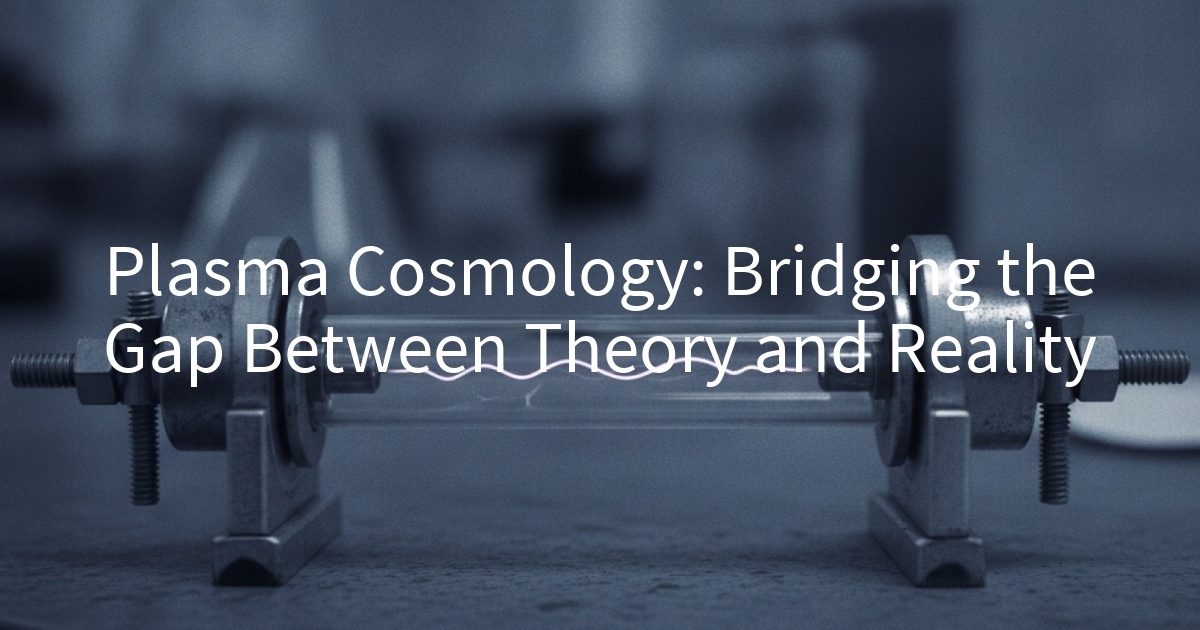
In the vast expanse of the universe, there exists a theory that challenges the very foundations of our understanding. It is a theory that asserts the pivotal role of electromagnetic forces in shaping the cosmos. Welcome to the world of plasma cosmology.
Plasma cosmology believes that electromagnetic forces play a far more significant role in the motion of astronomical objects than the prevailing theory of gravity alone. While mainstream astronomy acknowledges the importance of these forces, plasma cosmology goes further, suggesting that they have a profound impact on the workings of the universe.
However, it is important to note that plasma cosmology remains highly controversial and is widely rejected by the scientific community. Critics argue that this theory lacks empirical evidence and fails to stand up to rigorous scrutiny.
Join us as we delve into the intricacies of plasma cosmology, exploring its claims, its challenges, and the ongoing quest to bridge the gap between theory and reality in our understanding of the cosmos.
Understanding Plasma Cosmology: The Basics
Plasma cosmology offers a unique perspective on the universe, challenging the mainstream understanding of gravity-based expanding-Universe cosmology. At its core, plasma cosmology asserts that electromagnetic forces between plasma and magnetic fields play a pivotal role in shaping the motion of astronomical objects. This theory posits that these electromagnetic forces have a significant impact, potentially surpassing the influence of gravity alone.
This theoretical foundation positions plasma cosmology as far more than an abstract alternative — it functions as a working lens through which specific cosmic structures and events can be systematically re-examined. From the formation of galactic filaments to the behavior of solar phenomena, the framework offers interpretations grounded in electromagnetic dynamics rather than gravitational models alone. A closer look at plasma cosmology’s role in explaining cosmic phenomena reveals how proponents apply these principles to account for observations that conventional models have historically struggled to address.
Proponents of plasma cosmology argue that this alternative framework provides a more comprehensive explanation for various observations in the Solar System and the wider Universe. They highlight the unique ability of plasma to generate magnetic fields and electric currents, which in turn influence the dynamics of celestial bodies. However, mainstream astronomers counter that the current understanding of gravity-based cosmology can already account for these observations, without the need for a paradigm shift.
Although plasma cosmology presents intriguing possibilities, it lacks broad acceptance within the scientific community. The challenge lies in reconciling the differing perspectives of mainstream astronomy and plasma cosmology. While plasma cosmology offers simpler explanations for certain phenomena, it must overcome several hurdles. These challenges include the need for observational evidence supporting continuous matter creation, the violation of the First Law of Thermodynamics, and the absence of mathematical equations to substantiate its claims.
Central to this theoretical divide is how each framework interprets the origin and evolution of the universe itself. Plasma cosmology, rather than accepting a singular explosive genesis, proposes an alternative model in which electromagnetic forces and plasma dynamics have always governed cosmic structure on the largest scales. Plasma cosmology’s take on the Big Bang rejects the notion of a finite beginning altogether, arguing instead for an eternal, self-organizing universe shaped by electric currents — a position that places it in direct and fundamental conflict with the foundational assumptions of standard cosmological models.
The Challenges to Plasma Cosmology
Plasma cosmology, as an alternative theory to the mainstream understanding of the universe, faces several significant challenges. Critics of this theory argue that there is a lack of observational evidence to support the continuous creation of matter, which is a fundamental aspect of plasma cosmology. They point out that no instances of matter being spontaneously created out of nothing have ever been observed. This absence of empirical evidence undermines the credibility of plasma cosmology’s claims.
Furthermore, opponents of plasma cosmology contend that the theory violates the First Law of Thermodynamics, which states that mass/energy cannot be created or destroyed. They argue that the theory’s assertion of continuous matter creation contradicts this fundamental principle. The lack of mathematical equations that can support plasma cosmology’s claims further weakens its position in the scientific community. Without the rigorous mathematical framework to explain and predict observations, the theory lacks the necessary scientific foundation.
Plasma cosmology also struggles to explain several fundamental aspects of the universe that are well-explained by the current gravitational-based cosmology. These include the dark sky, microwave background, redshift, and Hubble expansion. The inability of plasma cosmology to provide comprehensive explanations for these phenomena raises doubts about its validity as a scientific theory. The scientific consensus remains skeptical of plasma cosmology due to these challenges and the lack of broader acceptance within the scientific community.
Challenges to Plasma Cosmology:
- Lack of observational evidence for continuous creation of matter
- Violation of the First Law of Thermodynamics
- Absence of mathematical equations to support claims
- Inability to explain fundamental aspects of the universe
While plasma cosmology presents an intriguing alternative perspective on the universe, these challenges highlight the need for further scrutiny and exploration. Scientific research and empirical evidence are crucial for validating any scientific theory, including plasma cosmology. As scientists from various disciplines continue to investigate the role of plasma and electromagnetic forces in shaping the universe, we strive to bridge the gap between theory and reality and further our understanding of the cosmos.
The Role of Plasma in the Universe
Plasma, a state of matter consisting of charged particles, plays a pivotal role in our understanding of the universe. Drawing upon principles from plasma physics and electrical engineering, plasma cosmology asserts that plasma’s unique properties contribute significantly to the dynamics of astronomical objects. These properties enable the formation of magnetic fields and electric currents that shape the motion of celestial bodies.
Plasma cosmology aligns with ongoing scientific research in astrophysics and cosmology, exploring the profound influence of plasma in the cosmos. By studying the behavior of charged particles in the universe, scientists aim to unravel the mysteries surrounding the formation of galaxies, star clusters, and other celestial structures.
While the role of plasma in the universe is still a subject of active debate, it is clear that understanding its properties and interactions is vital to advancing our comprehension of the cosmos. By exploring plasma cosmology, researchers expand their toolkit for investigating the universe and seek to bridge the gap between theory and reality in our exploration of the cosmos.
Entangled Views: The Standard Model vs. Plasma Cosmology
When it comes to understanding the inner workings of the universe, two contrasting perspectives emerge: the Standard Model and plasma cosmology. The Standard Model, which currently holds sway in the scientific community, relies heavily on the force of gravity to explain the motions of celestial objects. In contrast, plasma cosmology proposes a more comprehensive understanding that incorporates the influence of electric currents and magnetic fields.
The Standard Model has proven successful in explaining numerous observed phenomena. However, proponents of plasma cosmology argue that their theory offers simpler explanations for certain aspects of the universe. By considering the role of electric currents and magnetic fields, this alternative perspective seeks to bridge the gaps left by the gravity-centered approach of the Standard Model.
While plasma cosmology introduces intriguing possibilities, it struggles to gain widespread acceptance within the scientific community due to a lack of empirical evidence, mathematical rigor, and comprehensive explanatory power. Critics question the validity of the theory’s claims and emphasize the importance of empirical observation and mathematical modeling. As a result, plasma cosmology remains on the fringes of mainstream science, awaiting further scientific inquiry and verification.
The Crucial Role of Gravity and the Potential of Electric Currents and Magnetic Fields
The fundamental debate between the Standard Model and plasma cosmology revolves around the role of gravity versus that of electric currents and magnetic fields. The Standard Model attributes the vast majority of celestial motion to the force of gravity, while plasma cosmology suggests that electric currents and magnetic fields play a significant part. Both perspectives have their merits and limitations, and ongoing research seeks to explore the interplay between these forces to deepen our understanding of the universe.
- The Standard Model: Gravity as the Dominant Force
- Plasma Cosmology: Expanding the Paradigm
The Standard Model’s reliance on gravity as the dominant force stems from its success in explaining many astronomical phenomena. From the motion of planets in our solar system to the behavior of galaxies, gravity-based models have proven their worth. Gravity’s ability to shape the structure of the universe and guide the movement of celestial objects is well-documented and widely accepted within the scientific community.
Plasma cosmology challenges the gravity-centric paradigm by proposing that electric currents and magnetic fields exert a substantial influence on the dynamics of the universe. Proponents argue that plasma, a state of matter consisting of charged particles, plays a critical role in the formation of magnetic fields and the generation of electric currents. These plasma phenomena, according to plasma cosmology, contribute significantly to the motion of astronomical objects.
Overall, the contrasting views of the Standard Model and plasma cosmology reflect ongoing scientific inquiry into the nature of the universe. While the Standard Model has demonstrated its utility in explaining numerous phenomena, plasma cosmology strives to offer simpler explanations and a deeper understanding of the universe’s intricacies. Continued research and exploration are necessary to uncover the truths hidden within the entangled web of these competing perspectives.
Revisiting the Plasma Universe: Empirical Evidence and Alternate Explanations
Plasma cosmology, also known as the plasma universe, offers an intriguing alternative perspective on the nature of the cosmos. Proponents of this theory argue that it provides simpler explanations for observed phenomena and is supported by empirical evidence. At the heart of this theory is the understanding that plasma, a state of matter consisting of charged particles, plays a pivotal role in shaping the universe. Plasma’s unique properties enable the formation of magnetic fields and electric currents, which in turn influence the motion of objects in space.
Central to understanding these explanatory advantages is grasping what plasma actually does at cosmological scales. Plasma is not simply ionized gas — it carries electric currents, generates magnetic fields, and organizes itself into filaments and sheets that mirror the large-scale structure of the observable universe. the fundamentals of dark plasma extend this framework further, proposing that a non-luminous, electromagnetically active plasma component permeates the cosmos, providing the structural scaffolding that standard models attribute to invisible, undetected dark matter. With this foundation in place, plasma cosmology’s specific claims about galactic formation and cosmic filaments begin to carry considerably more weight.
One of the key advantages of plasma cosmology is its ability to explain certain phenomena more elegantly than the mainstream model. For example, the theory can account for the formation and behavior of galaxies, galaxy clusters, and cosmic filaments without the need for dark matter. Proponents also argue that plasma cosmology offers a more coherent explanation for the observed large-scale structure of the universe.
While plasma cosmology presents an intriguing alternative, it faces challenges and lacks widespread acceptance within the scientific community. Critics argue that the theory falls short in explaining fundamental aspects of the universe, such as the redshift, microwave background radiation, and the expansion of the universe. Additionally, there is a need for more rigorous testing and verification of the theory’s claims to establish it as a valid scientific framework. Nevertheless, ongoing research and exploration in the fields of plasma physics, astrophysics, and cosmology continue to shed light on the role of plasma and electromagnetic forces in shaping our understanding of the cosmos.
The Need for Further Inquiry and Understanding
In our quest to comprehend the vast complexities of the universe, ongoing scientific inquiry and exploration are imperative. While plasma cosmology presents an intriguing alternative to the mainstream understanding of the universe, it is crucial to gather further research and empirical evidence to validate its claims. Scientists from various disciplines, including plasma physics, astrophysics, and cosmology, are steadfast in their commitment to investigating the role of plasma and electromagnetic forces in shaping the cosmos.
By pushing the boundaries of knowledge and exploring alternative theories, we strive to bridge the gap between theory and reality in our understanding of the universe. The pursuit of inquiry and understanding propels us forward, encouraging us to challenge existing paradigms and delve into uncharted territories.
Scientific research plays a pivotal role in this process, shedding light on the intricate workings of the cosmos. With plasma cosmology and other alternative theories, scientists aim to uncover simpler explanations for observed phenomena and expand our comprehension of the universe’s fundamental principles.
Formal education plays a meaningful role in shaping researchers who can engage critically with both established and emerging cosmological frameworks. Pursuing a cosmology degree program in astrophysics equips students not only with the mathematical and observational tools needed to investigate the universe, but also with the intellectual flexibility to evaluate alternative models — including plasma cosmology — with rigor and curiosity. That combination of foundational training and open-minded inquiry is precisely what drives the kind of cross-disciplinary collaboration that moves the field forward.
As we continue our collective exploration, it is essential to remain open to different perspectives and approaches. By embracing scientific curiosity and fostering an environment of collaboration, we can collectively deepen our understanding of the universe and unlock its myriad mysteries.

Kyle Noble is the visionary founder and owner of DAPLA.org, a leading platform dedicated to exploring the enigmatic realms of dark plasma theory. With a profound expertise in theoretical particle physics, Kyle has carved a niche in the scientific community by delving into the fluid-like behavior of dark plasma, a self-interacting form of dark matter.